
How to Dress in the UAE: Climate, Culture, and Everything in Between
The UAE has a reputation for being strict about dress codes, and it also has a reputation for being a place where anything goes. Somehow, both of these are partially true, and the contradiction confuses a lot of newcomers. The reality is more nuanced: what you wear matters enormously in some contexts and barely at all in others, and learning to read those contexts quickly is one of the more useful skills you can develop as a resident or visitor.
Understanding the Two Separate Challenges
Dressing well in the UAE means solving two problems that pull in opposite directions. The climate asks you to wear as little as possible. Temperatures between June and September regularly exceed forty degrees, and even the milder months from November to March can feel warm by midday. The cultural context, on the other hand, asks for modesty in public spaces, and the definition of public is broader here than most Westerners initially assume.
The people who dress badly in the UAE are usually failing at one of these two problems. Tourists occasionally show up to a mall or a mosque in beachwear because they underestimated the cultural expectations. Long-term residents sometimes overcorrect in the other direction, wearing thick layers out of misplaced caution and spending the summer in genuine physical discomfort. Getting it right means understanding both challenges clearly and building a wardrobe that handles them simultaneously.
What the Climate Actually Requires
Lightweight, breathable, and loose-fitting are the three qualities that matter most. Linen, cotton, and moisture-wicking fabrics do the work here. Tight synthetic clothing that looks fine in a European summer becomes unbearable by nine in the morning in July. Dark colours absorb heat faster than light ones, which is obvious in theory but easy to forget when you are standing in a shopping centre deciding what to buy.
Long sleeves in a loose, breathable fabric are often more comfortable in direct sun than bare arms, because they protect the skin from radiation while still allowing air to circulate. This is counterintuitive to people from cooler climates, but it is why traditional Gulf dress is designed the way it is. The kandura and abaya are not just expressions of culture — they are genuinely well-adapted to the environment.
The indoor-outdoor temperature difference in the UAE is also worth taking seriously. Air conditioning is aggressive, and the gap between outside and inside can easily reach fifteen degrees or more. Many people, particularly women in office environments, keep a light layer at their desk year-round because the buildings are simply cold. Dressing in layers, or keeping something to throw on indoors, is not overthinking — it is a practical response to a real daily experience.
Public Spaces and the Modesty Standard
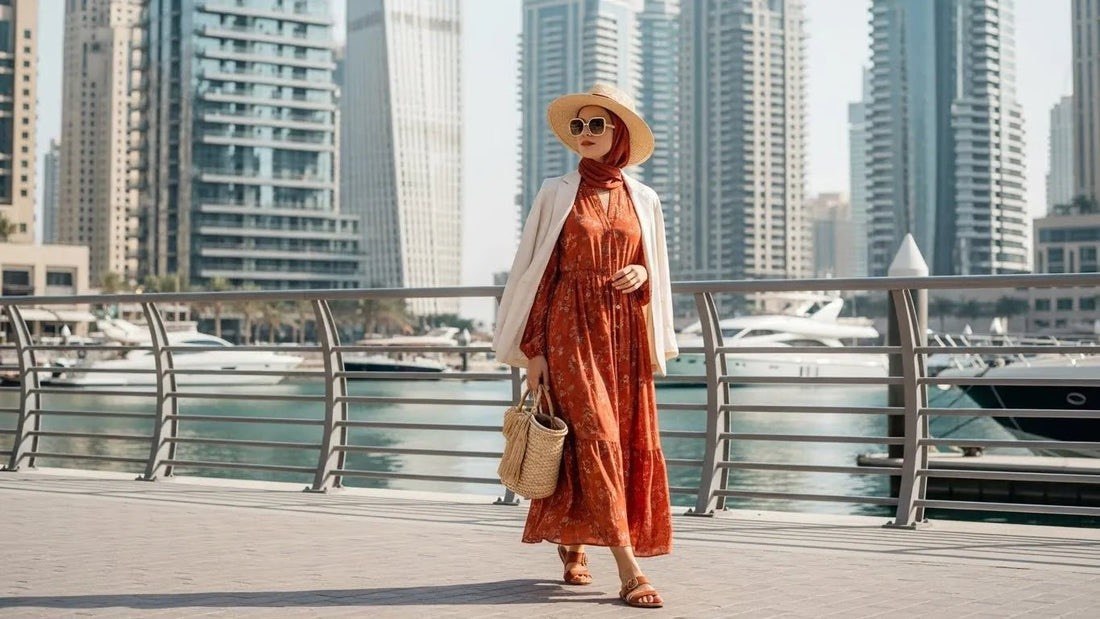
The general rule for public spaces in the UAE is that clothing should cover the shoulders and knees. This applies in shopping malls, markets, government buildings, public transport, and general street settings. It is not rigidly enforced in every situation, but it is a genuine social expectation, and visibly ignoring it in the wrong context draws attention and occasionally prompts a quiet word from security staff.
The standard applies to everyone, regardless of gender or nationality. Men in shorts that end well above the knee and sleeveless shirts are technically in the same position as women in similar clothing, though in practice women’s dress tends to attract more scrutiny. The sensible approach for both is to treat the shoulders-and-knees rule as the baseline for anything that is not a beach or a pool.
Swimwear belongs at the beach and the pool, not on the walk to the hotel lobby or the drive-through on the way home. This is one of the areas where tourists most commonly get it wrong, and while the consequences are rarely severe, it is worth avoiding on basic grounds of respect.
Mosques and Religious Sites
The rules here are stricter and non-negotiable. Women visiting mosques are required to cover their hair, arms, and legs fully. Most major mosques, including the Sheikh Zayed Grand Mosque in Abu Dhabi, provide abayas and head coverings at the entrance for visitors who arrive unprepared, which is a practical and generous gesture. That said, arriving already appropriately dressed is both more comfortable and more respectful.
Men need to cover their shoulders and wear long trousers. The casual beach outfit that might pass unnoticed in a mall will not be acceptable at the entrance to a mosque. These are among the clearest and least ambiguous dress requirements in the UAE, and they are easy to meet with a small amount of planning.
Workplaces and Business Settings
The professional dress code in the UAE varies significantly by sector and by the nationality makeup of the organisation. International companies operating in free zones like DIFC or Dubai Internet City often have dress cultures that look similar to what you would find in London or Singapore. Government-adjacent offices and institutions with a more local character tend to expect more formal and conservative dress.
When in doubt, it is always better to be slightly more formal on the first day and calibrate from there. Turning up overdressed to a casual office is easily corrected. Turning up underdressed to a conservative government meeting is not the impression you want to create.
For women in professional settings, the same fabrics that work for the climate also tend to work for the office. Structured linen trousers, long-sleeved blouses in lightweight materials, and midi-length skirts hit the intersection of professional, modest, and genuinely wearable in the heat. The UAE professional wardrobe is one area where investing in a few good pieces pays back quickly.
Nightlife, Restaurants, and Hotels
Licensed venues, hotel bars, and upscale restaurants operate under a different set of expectations than public spaces. The dress standard here is closer to what you would find in any cosmopolitan city. Smart casual to dressed up is the norm depending on the venue, and the modesty rules of public streets largely do not apply inside these spaces.
This does not mean anything goes. Venues have their own standards, and very casual or visibly sloppy dress can result in being turned away at the door of a nicer restaurant or club. But a sleeveless dress at a hotel rooftop bar or an open-collar shirt at a licensed restaurant is perfectly normal and expected.
A Note on Cultural Sensitivity Beyond the Rules
There is a version of dressing in the UAE that is technically compliant and still somehow disrespectful, and it is worth being honest about. The written rules set a floor, not a ceiling. During Ramadan, for example, the expectation for modesty in public rises noticeably, and many residents adjust their dress accordingly out of awareness rather than obligation. Dressing in a way that visibly ignores the cultural context of the season or the setting, even while staying within the technical rules, is its own kind of tone-deafness.
The UAE is genuinely multicultural and accommodating of a wide range of styles. It asks, in return, for a basic level of attention to context. Most long-term residents find that this is not a burden at all — it becomes second nature within the first few months, the way navigating any new city’s unwritten social codes eventually becomes automatic.
The wardrobe that works best here is one that was built with both the climate and the culture in mind from the start, rather than one imported wholesale from somewhere else and grudgingly adjusted when problems arise. That small shift in thinking makes the whole thing considerably easier.

Stands, graphics and AV equipment spend more time in storage than on the show floor. Here is how event companies in Dubai store them safely and get them out fast.
 The UAE’s National Immunization Program: What Parents Need to Know
One of the more reassuring things about raising children in the UAE is how seriously the country takes childhood vaccination.
 Launching an Online Store in the UAE: Licensing and the Logistics That Make or Break It
The UAE e-commerce market has reached a scale that makes it impossible to ignore. The market was valued at USD 8.8 billion in 2024 and is expected to exceed USD 13.8 billion by 2029.
 Freelancing Legally in the UAE: Licenses, Costs, and What Actually Works in 2026
The UAE has built a genuine reputation as one of the best places in the world to freelance, and the numbers back it up. By 2025, the UAE had risen to second place in the global ranking of countries for freelancers and digital nomads, with most of those professionals based in Dubai.
The UAE has built a genuine reputation as one of the best places in the world to freelance, and the numbers back it up. By 2025, the UAE had risen to second place in the global ranking of countries for freelancers and digital nomads, with most of those professionals based in Dubai.
Most expats in the UAE never learn Arabic. English gets you through almost everything in Dubai and Abu Dhabi, and the sheer diversity of the population means that on any given day you might interact with people from twenty different countries without a single Arabic word being exchanged.
Planning to move to Dubai? Here’s a realistic breakdown of the cost of living in Dubai in 2026 — rent by area, school fees, utilities, transport, and health insurance, with actual AED figures.